
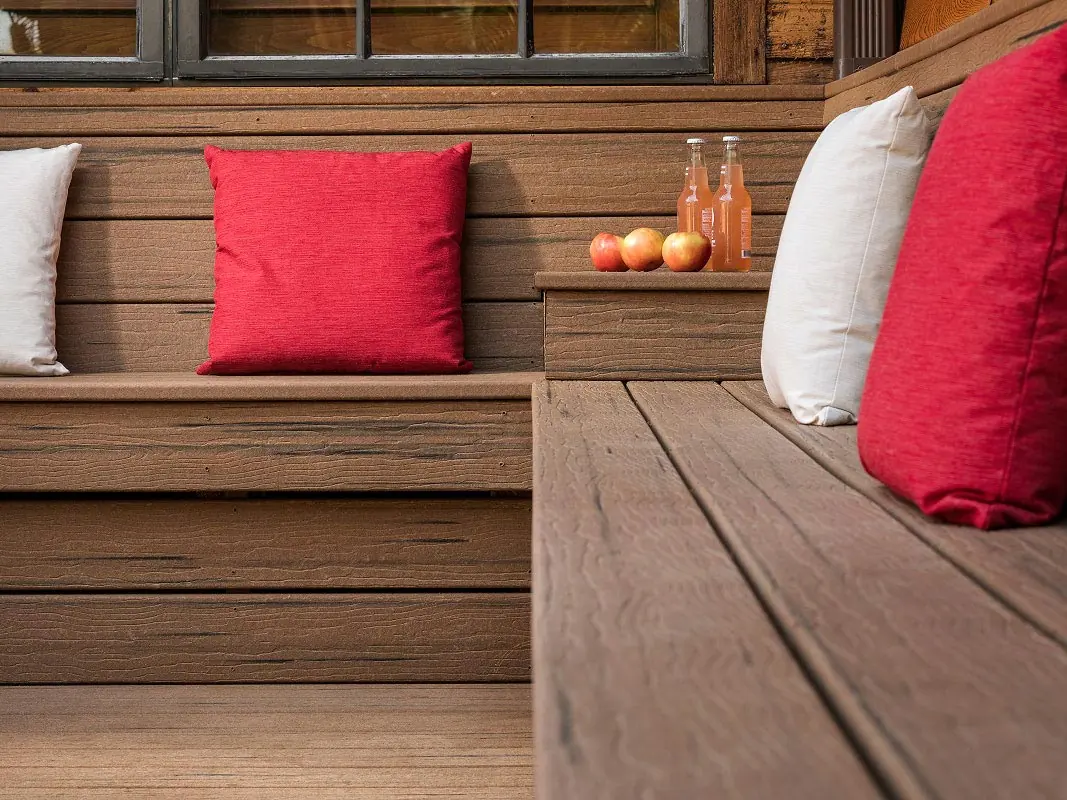
Built-in deck seating is a bench framed into the deck itself, usually along an edge or wrapped into a corner, and finished in the same boards as the deck floor. Louisville Decks builds benches into new decks and adds them to existing ones in Louisville. A built-in bench seats more people than loose chairs in the same footprint, and it never needs dragging in before a storm.
Sizes that make a bench comfortable
| Measure | Typical range |
|---|---|
| Seat height | 17 to 19 inches |
| Seat depth | 15 to 18 inches, deeper if you use cushions |
| Backrest angle | About 100 to 110 degrees from the seat |
| Backrest height | 15 to 18 inches above the seat |
A bench frame should tie into the deck joists or blocking, not sit on top of the boards. That keeps it from shifting and lets water drain off the deck surface underneath.
Benches and the 30-inch rule
On a deck 30 inches or less above grade, a backless bench can sit right at the edge and mark it. On a higher deck the code generally requires a guard, and a bench pushed against that guard becomes a step up for a climbing child. Some inspectors measure the required guard height from the seat rather than the deck floor when a bench sits against the rail, which means a taller guard or a bench set back from the edge. Ask the permit office before designing around it. Our deck builder turns railing on automatically once a deck passes 30 inches, and deck railing and stair replacement covers the guard rules in full.
Boards that stay comfortable in the sun
A bench seat meets bare legs, so surface heat matters more there than on the floor. If the deck is MoistureShield, our primary decking, look at the CoolDeck colors in its Vision and Meridian lines; MoistureShield says they absorb up to 35% less heat. In any material, lighter colors run cooler than dark ones, and wood generally stays cooler than composite, though cedar weathers to silver unless sealed.
Matching the bench to the deck boards and fascia makes it look built in rather than added. The materials page compares the options.
Bench styles
- Perimeter bench with a back. Runs along one edge; on a low deck it can double as the edge itself.
- Corner (L-shaped) bench. Two runs meeting at a corner, the most seats per foot of deck.
- Backless bench. Defines an edge on a low deck without blocking the view.
- Storage bench. A hinged lid over a box for cushions, with drainage holes, since water will get in.
- Bench with a screen behind it. A privacy screen doubles as a tall backrest.
A strip of deck lighting under the front edge of the seat lights the floor at night without glare.
What built-in seating costs
HomeGuide puts a built-in deck bench at roughly $1,000 to $1,500. Length, a backrest, storage and the board material move it. You can add a bench of any length in the deck builder and send us the plan; the real price is set on site.
Benches cost least when they go in with the deck, so bring them up at the start of custom deck design and construction. Call or text (502) 561-0375 to plan seating.
Questions homeowners ask about built-in deck benches
How do you build a corner bench on a deck?
Run two bench frames to meet at the corner, with a post or block at the inside corner carrying both seats, and fasten the frames to the deck joists or blocking. Miter or overlap the seat boards where they meet.
What type of wood should I use to make a bench?
For an outdoor bench, cedar or pressure-treated pine. Cedar is lighter and more stable; pine costs less and takes stain. On a composite deck, matching composite boards over a treated frame keep the look consistent and need no stain.
What is the best weatherproof outdoor bench?
One with nothing to rot or rust: a treated or composite frame, capped composite or sealed cedar seat boards, coated or stainless fasteners, and gaps so water runs off the seat.
What is the best angle for a bench backrest?
Most comfortable benches tilt the back about 100 to 110 degrees from the seat, which is 10 to 20 degrees past vertical.