
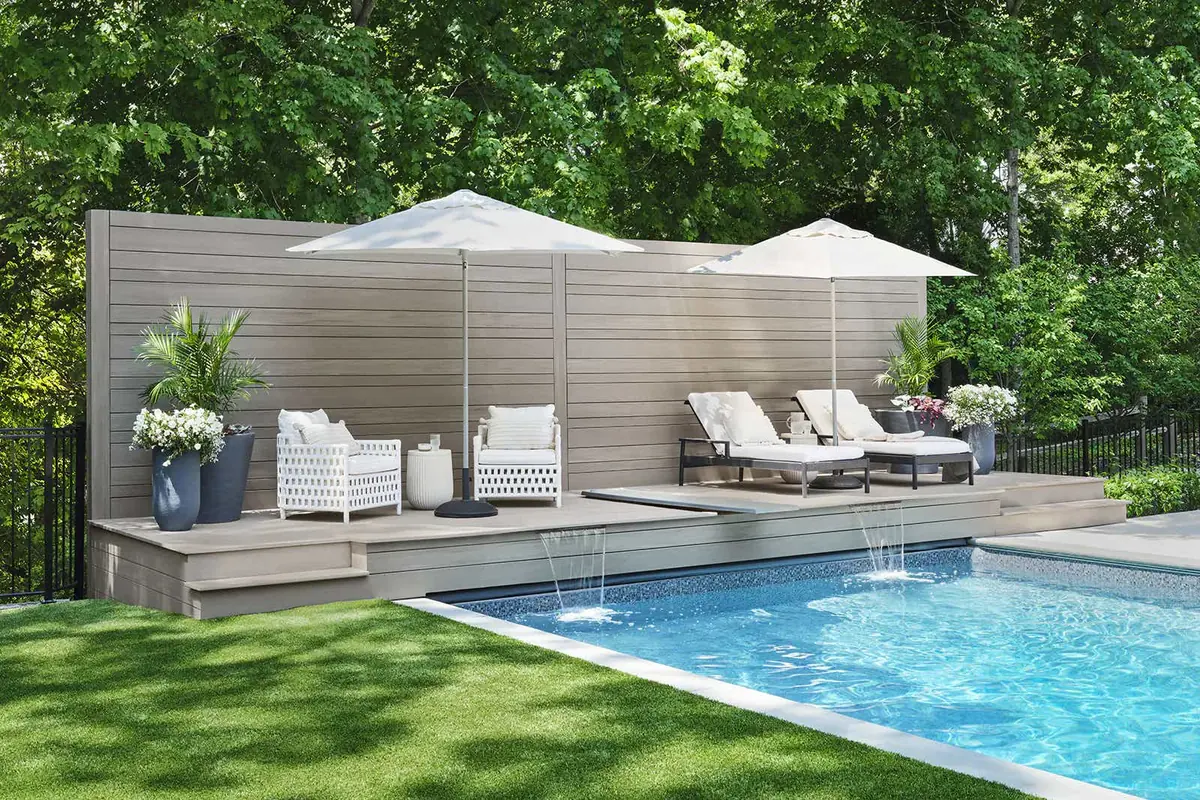
A deck privacy screen is a slatted or solid wall along one side of a deck that blocks a neighbor’s view, the wind or the low afternoon sun. Louisville Decks builds privacy screens into new decks and adds them to existing ones in Louisville, in cedar, pressure-treated pine or composite. What decides whether a screen lasts is not the slats. It is how the posts are tied into the deck frame.
Why the posts matter more than the slats
A 6-foot screen catches wind like a sail, and that force levers against the base of every post. Posts screwed to deck boards, or lagged to the outside face of a rim joist, work loose. A solid screen post is through-bolted to the framing with blocking behind it, or runs down to its own footing. On an existing deck, that can mean lifting a few boards to add blocking before the screen goes up.
Gaps between slats let some wind pass and lower the load, and narrow gaps still block most of the view. A fully solid wall is the hardest on its posts.
Screen styles
| Style | Look | Notes |
|---|---|---|
| Horizontal slats | Clean, modern lines | Slats need support every few feet to stay straight |
| Vertical boards | Fence-like, traditional | Easy to match to wood railings |
| Lattice panels | Light, partial privacy | Lowest cost; good for climbing plants |
| Louvers | Angled slats | Blocks the view from one direction while air moves through |
Cedar weathers to silver unless it is sealed; pressure-treated pine takes stain. Composite is heavier and more flexible than wood, so composite slats need closer supports to avoid sagging. If your deck is MoistureShield, our primary decking, or TimberTech or Trex, ask about facing the screen to match. Not every composite deck board is meant for vertical use, so the maker’s installation rules decide which boards can go on a wall. The materials page covers each product.
Height, guards and neighbors
- Raised decks. On a deck more than 30 inches above grade, a screen along an open edge either becomes part of the code guard, and has to meet the guard rules, or stands inside a compliant railing. See deck railing and stair replacement.
- HOAs and neighbors. Neighborhood associations often limit screen and fence heights. Check before designing a tall wall.
- Covered decks. Roof posts are already anchored to carry a roof, which makes them a natural place to hang a screen. Louisville Decks is the deck division of Louisville Roofing, so on a covered deck the screen can be planned along with the roof.
- Pergolas. A screen between two pergola posts adds privacy on one side and keeps the rest open.
Pricing a privacy screen
A screen is priced by the linear foot, and height, material and how much work the posts need move it most. Our deck builder includes a privacy screen as an extra, so it goes into the plan you send us with the rest of the deck. The real price is set on site, after we see how the posts can be anchored. Call or text (502) 561-0375 with the side of the deck you want screened.
A screen also makes a good backrest for a built-in bench, and it is easiest to add while the deck frame is open during custom deck design and construction.
Questions homeowners ask about deck privacy screens
How do I add privacy to my deck?
A slatted screen anchored to the deck frame is the most permanent option. Lattice panels, tall planters, a screen on one side of a pergola, or outdoor curtains under a covered deck roof also work.
Can you put a fence on a deck?
Yes, but it has to anchor to the deck’s structure rather than the boards, because wind load on a tall screen is far higher than on a railing. Many decks need added blocking or posts before a screen goes on.
What is the cheapest way to add privacy to my backyard?
Lattice panels, or planters with tall grasses or shrubs, cost the least. A built slat screen costs more but blocks more and holds up in wind.
What are some good options for outdoor privacy walls for decks?
Horizontal cedar slats, framed composite screens, vertical board walls and louvered panels. Choose by how much air you want to pass through and whether the wall needs to match the decking.