
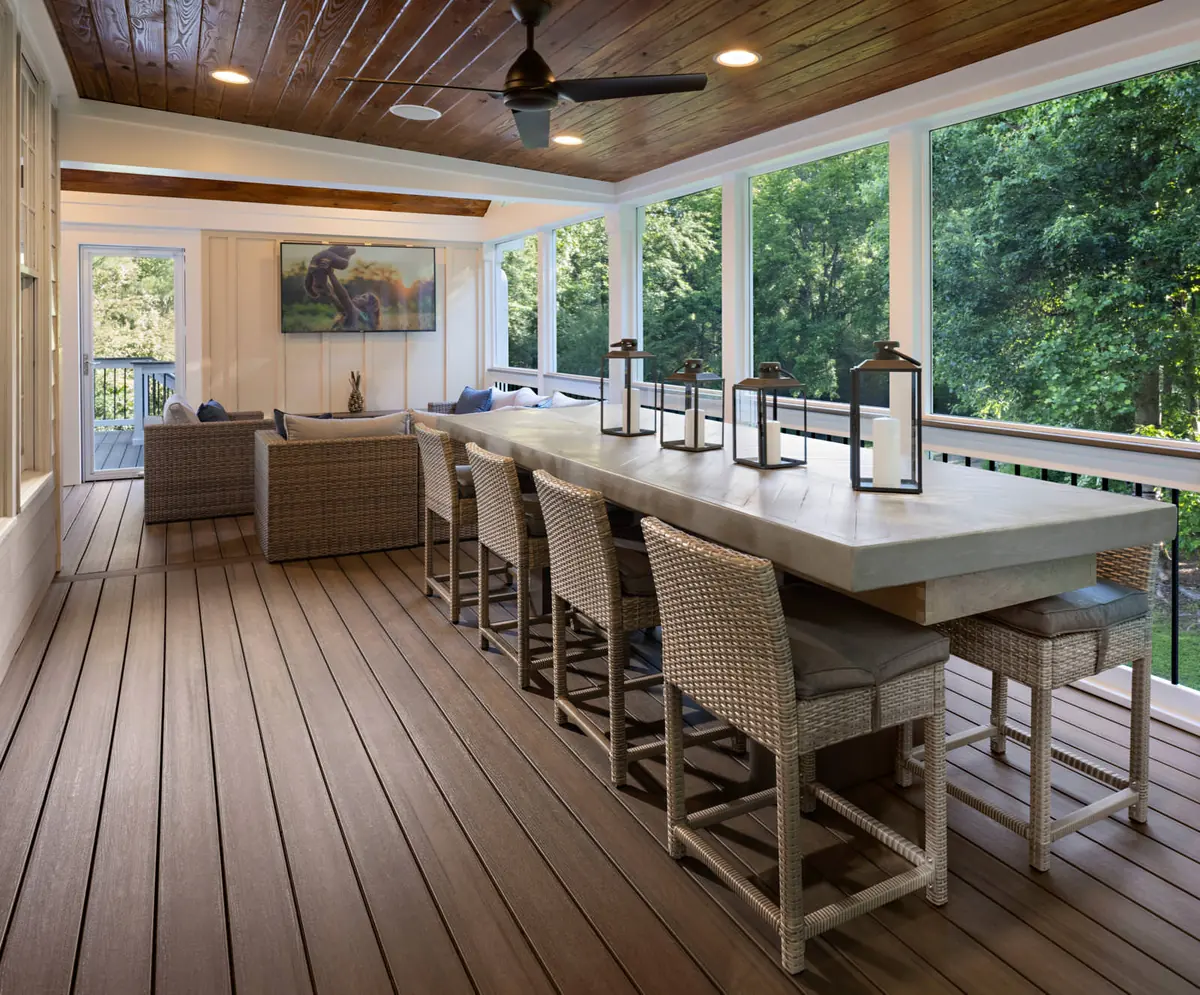
A three-season room is a roofed room on a deck or slab, enclosed with windows instead of screens, and not heated or cooled with the rest of the house. In Louisville it gives you a usable room from early spring into late fall, plus the odd sunny winter afternoon. Louisville Decks builds three-season rooms on new decks and over existing ones, and the roof comes from our own company, since we are the deck division of Louisville Roofing.
Screened porch, three-season room or four-season room?
| Screened porch | Three-season room | Four-season room | |
|---|---|---|---|
| Walls | Screens | Windows, often single-pane glass or vinyl panels | Insulated walls and insulated glass |
| Heating and cooling | None | None, or a portable heater | Part of the house system or its own |
| Typical use | Late spring to early fall | Spring through fall | All year |
A four-season room is closer to a house addition, with an insulated floor, walls and roof, and it is permitted as living space. A three-season room keeps the lighter build of a deck with a roof, which is why it costs less. If you want screens instead, see screened-in porches.
Start with the roof
A three-season room is a covered deck with walls, so the roof sets the limits. The beam along the open sides has to sit high enough for full-height windows, the roof pitch has to clear the house’s eaves, and the tie-in to the house has to stay dry with glass now trapping any leak inside. Those are roofing decisions, and they are planned by the same company that frames the deck. The parent page, covered decks and roofs over existing decks, covers roof styles and tie-ins in more detail.
Our own covered deck project shows how close the two are. It is a raised second-story deck with a gable roof and a beadboard ceiling with recessed lights. Put window walls between its posts and it would be a three-season room.
Converting a screened porch
If you already have a screened porch, the roof and floor are in place. The work is swapping screen walls for window units, which may mean reframing between posts to fit standard window sizes, adding a short kick wall at the bottom, and closing the gaps between deck boards. Those gaps matter more once the room is enclosed, because cold air comes up through them.
For the floor, composite boards hold up well in a room that sees humidity swings but no direct rain. MoistureShield, our primary decking, describes its boards as a capped composite with a solid core. Other options are on the materials page.
What a three-season room costs
HomeGuide’s August 2025 sunroom data puts a 12-by-12 room at about $11,500 to $33,000. Window type, roof style, ceiling finish, and whether the deck already exists move the price within that range.
The deck builder includes a three-season room as an overhead option on a new or existing deck, so you can send us the plan. Real prices are set on site. Lights and a ceiling fan are worth planning at the same time; see deck lighting. Call or text (502) 561-0375 to talk it through.
Questions homeowners ask about three-season rooms
Is it a 3 season or 4 season room?
If it has no heating or cooling and its walls and glass are not insulated, it is a three-season room. A four-season room is insulated and conditioned so it can be used all year.
How do you turn a screened-in porch into a 3 season room?
Replace the screen walls with window units, close the bottom with a kick wall, and seal the floor gaps. Check the roof and posts first: if the porch roof leaks or sags, fix that before adding glass.
How much does a 3 season porch cost to build?
HomeGuide’s sunroom figures for a 12-by-12 room run about $11,500 to $33,000. Building on an existing deck with a sound roof costs less than starting from bare ground.
What are the pros and cons of a 3-season room?
Pros: more months outside, shelter from rain, wind and pollen, and furniture can stay out. Cons: it costs more than a screened porch, it is too cold for daily use in midwinter, and it can run hot in full summer sun without shade or airflow.
Can I put a regular couch in a 3 season room?
You can, but the room is not climate-controlled, so humidity swings can leave indoor fabrics musty or mildewed. Outdoor furniture and fabrics hold up better.